1D Swing Nozzle
Single-axis swing with position feedback — the workhorse of musical choreography.
Explore →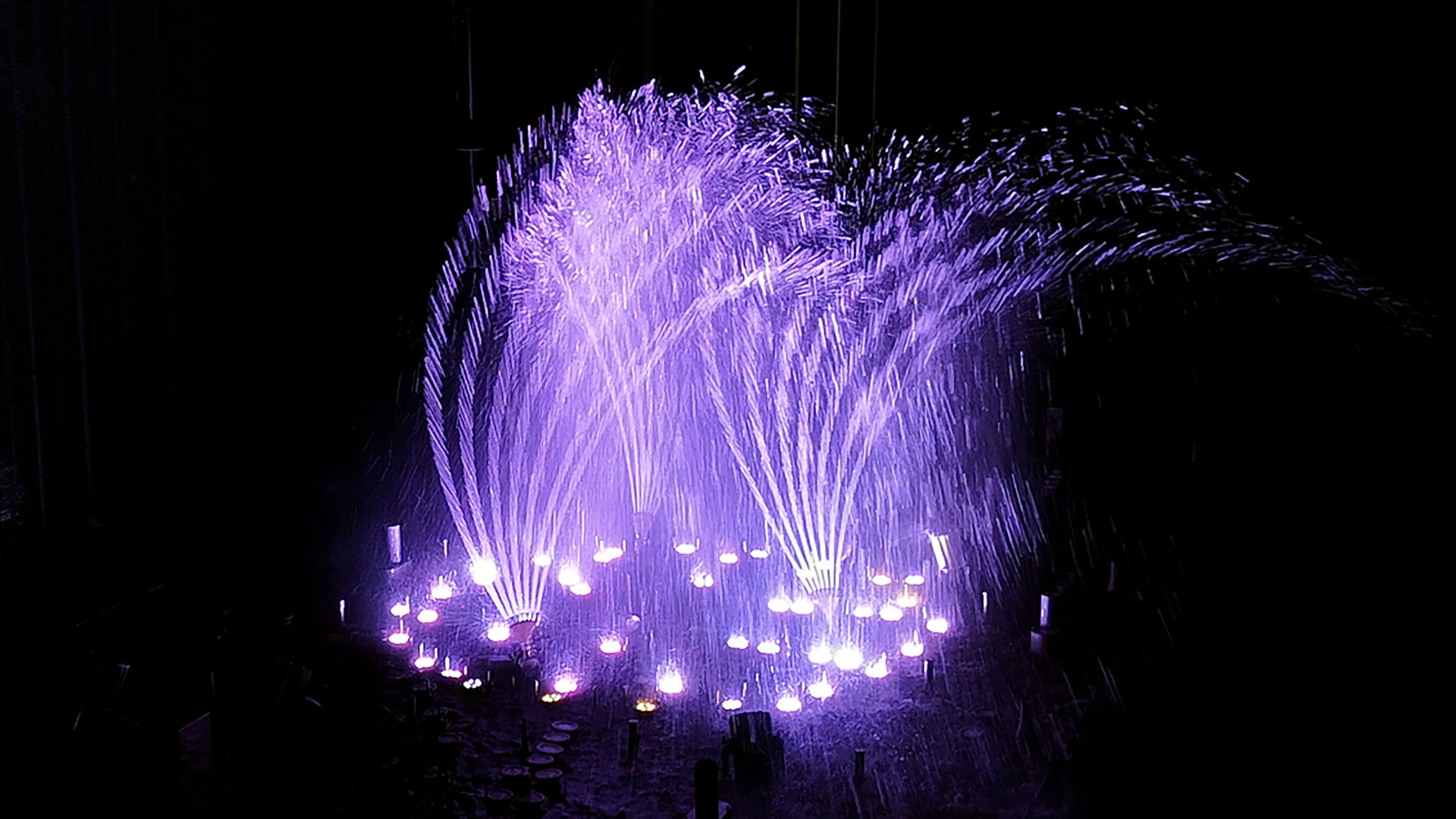
Static jets make patterns. Motion-controlled jets make movement: robotic nozzles that swing, rotate and answer the music axis by axis. This is the equipment family behind the dancing in a dancing fountain.
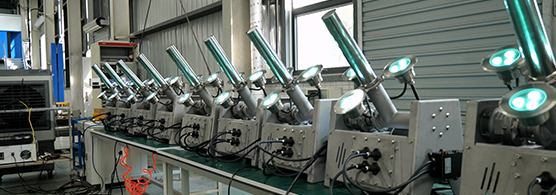
A motion-controlled jet system replaces fixed nozzles with driven units whose direction is programmed. In a 1D unit the jet swings on one axis; a 2D unit adds a second axis so the jet can draw circles, waves and crossing patterns; a 3D unit controls three axes and can rotate its nozzle head through a full performance vocabulary. Multiply one unit by a field of dozens, all answering the same control timeline, and the water itself starts to choreograph.
Unit values are set out below. Specifications vary by unit; confirm the exact configuration for your project before ordering.
| Unit | Movement | Stated details |
|---|---|---|
| 1D standard | Single-axis swing with position feedback | DN40 / DN50 connections |
| 1D integrated | Single-axis swing, ±60° | DMX512 control; 3 × 9 W RGB lighting |
| 1D dual / triple-nozzle | Selectable nozzle positions | Triple-nozzle spacing 120° |
| 2D low-profile | ±80° lower axis, 360° upper axis | Internal / external slip ring designs |
| 2D multi-nozzle | Dual-axis movement | DN50 outlets; 360° upper-axis rotation (dual) |
| 3D integrated | Three independently controlled axes | 360° nozzle-head rotation; integrated RGB; DMX512-compatible |
More axes buy more vocabulary, not automatically a better show. A field of 1D swing units produces the great wave and chase effects that carry most musical numbers, at the simplest mechanical scope. 2D units earn their place where the choreography needs circles, crossings and figure patterns — the centre of a dancing fountain, for example. 3D units are feature instruments: a small number placed where the audience watches closest.
The design stage mixes the field deliberately: effect zones of 1D units for the body of the show, 2D clusters for feature passages, and the control program written against the actual installed mix. Because Aqualume manufactures the units and the cabinets in the same scope, the DMX addressing, cabling and programming arrive as one integrated system.
The table above states the units; our comparison of 1D, 2D and 3D jets compares what each axis count lets a show say — waves, figures and solos — and the buying mistakes that follow from counting axes instead of vocabulary.
Both are possible. On the integrated variants, DMX512 control lets each unit carry its own address for full choreography; units can also be grouped into effect zones that move together — the program decides.
Where the water supply, basin structure and control capacity allow, yes. Send the existing layout and the effect you want to add; the assessment starts from the installed base.
No — movement ranges and electrical specifications vary by unit, exactly as the source page states. Confirm the configuration of the specific unit in your quotation.