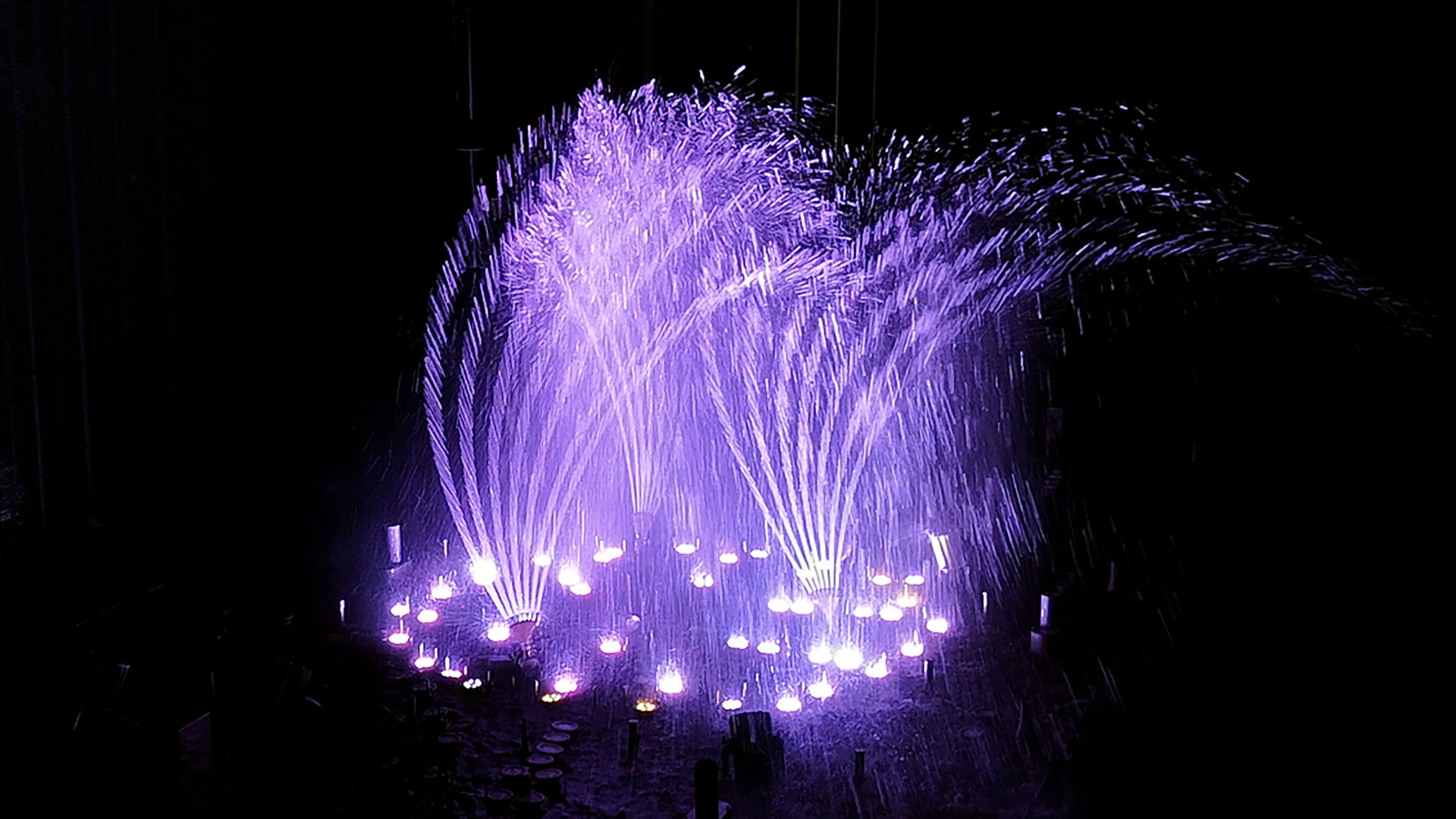
1D Swing Nozzle
The 1D swing nozzle is the workhorse of musical choreography: one driven axis, a jet that sways, leans and chases on command, with position feedback so the program always knows where the water is pointing.
- Single-axis swing
- Position feedback
- DN40 / DN50
- DMX512 variants
1D Swing Nozzles: Movement and Connections
A 1D unit drives its jet through a programmable swing on a single axis. Individually that sounds modest; in a field of dozens it is the vocabulary of the classic musical fountain — the travelling wave that rolls across a basin, the chase that answers a drum line, the slow collective sway under a quiet passage.
| Variant | Stated details |
|---|---|
| 1D standard | Programmable single-axis swing; position feedback; DN40 / DN50 connections |
| 1D integrated | DMX512 control; 3 × 9 W RGB lighting; ±60° swivel range |
| 1D dual / triple-nozzle | Two or three selectable nozzle positions; triple-nozzle spacing 120° |
Specifications vary by unit; confirm the exact configuration for your project before ordering. Position feedback is the line to notice: it closes the loop between program and water, so a field of 1D units holds its synchronisation through a whole performance instead of drifting into approximation.
Where 1D Fields Do the Work
Most of any musical show's minutes are 1D minutes. The swing field forms the body of the choreography — the zones that move constantly under the music — while costlier multi-axis units are saved for feature passages. That economics is why 1D selection matters: connection sizes against your pipework, the integrated lighting variant where the lighting plan wants light at the jet's base, and the dual/triple-nozzle variants where one drive should serve more than one pattern.
The design stage mixes the field deliberately, zone by zone. If you are specifying units for an existing basin, send the layout and the effects you want to add; the assessment maps swing arcs against basin edges and neighbouring jets before any unit count is proposed.
Specifying a 1D Field: Counts, Zones and Spares
A 1D field is specified in zones before it is specified in units. Decide the travelling paths the choreography needs — the long wave across the basin, the ring chase, the answering pair — and the zone boundaries fall out of the music's geography. Unit counts then follow from spacing that keeps patterns continuous: close enough that a wave reads as water in motion rather than as separate jets taking turns, far enough that neighbouring arcs never collide at full swing.
Two practical lines belong in every 1D specification. First, the integrated-lighting decision: fields whose lighting plan wants light at the jet base should take the integrated variant from the start, because retrofitting light into a swing field is surgery. Second, spares: a field of working units in public water should carry spare units and a swap routine in its maintenance plan, so a failed drive is an afternoon's work rather than a hole in the show.
1D Swing Nozzle Questions
What does position feedback change in practice?
The control system knows each unit's actual angle, not just the commanded one. Fields stay in step, and a unit that cannot reach its position is visible to the operator instead of silently spoiling the pattern.
Can 1D units work with lights only, no music?
Yes — the program can run visual-only sequences. The integrated RGB variant carries its lighting on the same DMX512 control as the movement.
Are DN40 and DN50 both standard?
Both connections are stated for the 1D standard unit. Confirm the size against your pipework design in the quotation.