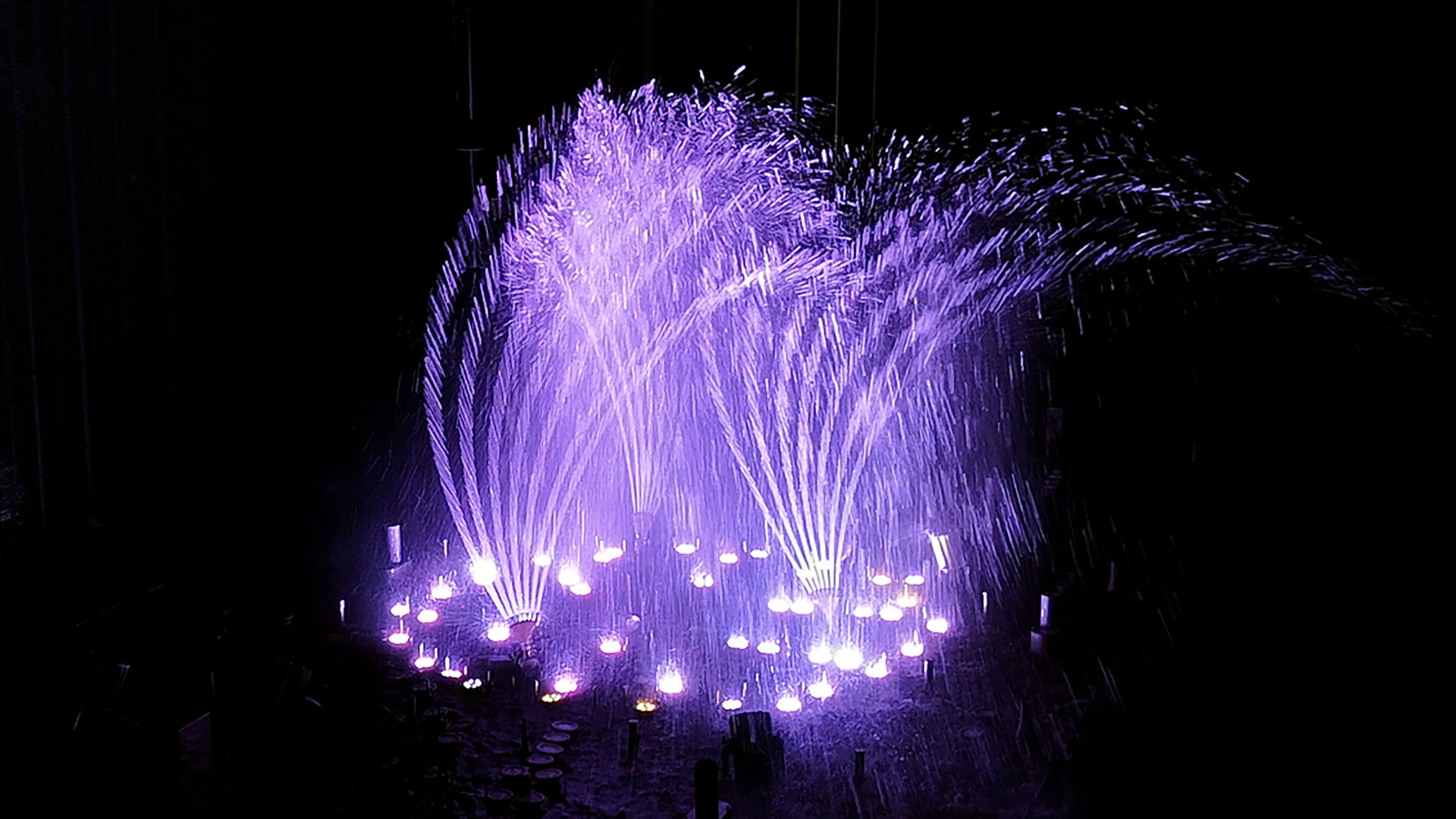
3D Fountain Nozzle
The 3D unit is the soloist: three independently controlled axes and a nozzle head that rotates through a full circle, giving one jet a performance vocabulary that whole fields of simpler units cannot imitate.
- Three-axis control
- 360° head rotation
- Integrated RGB
- Feature instrument
3D Fountain Nozzles: the Feature Instrument
A 3D integrated unit controls three axes independently and rotates its nozzle head through 360°, with integrated RGB lighting and DMX512-compatible control. In performance terms, that means the jet can lean, sweep and spin in combination, tracing spirals and revolving figures that read as a solo performance rather than a pattern.
| Item | Stated details |
|---|---|
| Axes | Three independently controlled axes |
| Nozzle head | 360° rotation |
| Lighting | Integrated RGB |
| Control | DMX512-compatible |
Specifications vary by unit; confirm the exact configuration for your project before ordering. The 3D unit's value is concentration, not coverage: it exists to be watched, which is why its page in the motion family is about placement as much as hardware.
Where a Soloist Belongs
Place a 3D unit where the audience's attention already gathers: the centre of a dancing basin, the focus of an entrance court, the single feature in a compact feature pool. Surround it with a disciplined field — 1D units for the body's movement, perhaps a 2D cluster for answering figures — and program the solo passages the way a concert programs a soloist: sparingly, at the peaks, against a quieter field.
Programmed carelessly, a 3D unit is a gimmick that exhausts its novelty in one evening. Programmed with restraint, it becomes the signature — the movement visitors describe to friends. The design and programming scope is where that difference is made, and it is included in the conversation when a 3D unit is specified into an Aqualume show.
The Soloist's Contract: What to Agree Before It Ships
Because a 3D unit is bought for a handful of passages, those passages should be agreed — in words, in the project documents — before the unit is specified. Which moments of which programs does the soloist own? What does the field do while it performs? Who signs off the programmed result, and from which seat? Projects that answer these questions own a signature. Projects that skip them own an expensive unit performing party tricks at random intervals.
Agree also the negative space: the passages where the unit is contractually still. It sounds precious until opening month, when every stakeholder with a favourite song wants the soloist in it. The unit's scarcity is a resource; like the feature jet's height or the flame's appearances, it is spent by the program and protected by the agreement. That is the soloist's contract, and it is why the design conversation around this small page is disproportionately long.
A Note on the Photograph Problem
The 3D unit suffers a peculiar marketing fate: its best moments are movements, and movements photograph as blurs. Stills of this family undersell it in both directions — freezing a spiral into a shape it never holds, or smearing a figure into weather. Judge it, where you can, on programmed video from a real installation, watched at audience distance, inside a whole show rather than as a solo demo. A unit that mesmerises for thirty seconds alone and vanishes inside a program is a demo product; the one specified here is bought to do the opposite.
3D Fountain Nozzle Questions
How many 3D units should a project buy?
Usually very few — one feature position, or a small symmetric group in a large basin. The design review will argue against over-buying; the unit's value is scarcity.
Can a 3D unit retrofit into an existing show?
Where water supply and control capacity allow, a feature position can be created in an existing field. Send the layout; the assessment covers supply, sightlines and programming.
Does it run the same control as the rest of the family?
Yes — the 3D unit's listed DMX512-compatible control is designed to sit on the same timeline as the 1D and 2D fields and the lighting.