2D Swing Nozzle
Add a second axis and the jet stops swaying and starts drawing: circles, waves that travel in two dimensions, crossing patterns that intersect mid-air. The 2D unit is where a dancing fountain earns its name.
- Dual-axis movement
- Circles & crossings
- DMX512 integrated variant
- Feature passages
2D Swing Nozzles: Two Axes of Choreography
A 2D unit controls its jet on two axes at once, so the water can trace continuous figures — a circle, a figure-eight, a wave that runs diagonally across the field — and pairs of units can cross their jets in programmed intersections. Specifications vary by unit, and the exact configuration for your project is confirmed before ordering.
| Variant | Stated details |
|---|---|
| 2D designs | Internal / external slip ring designs |
| 2D low-profile | ±80° lower-axis movement; 360° upper-axis rotation |
| 2D integrated | RGB lighting with DMX512 control |
| 2D multi-nozzle (dual / triple) | DN50 outlets; 360° upper-axis rotation (dual) |
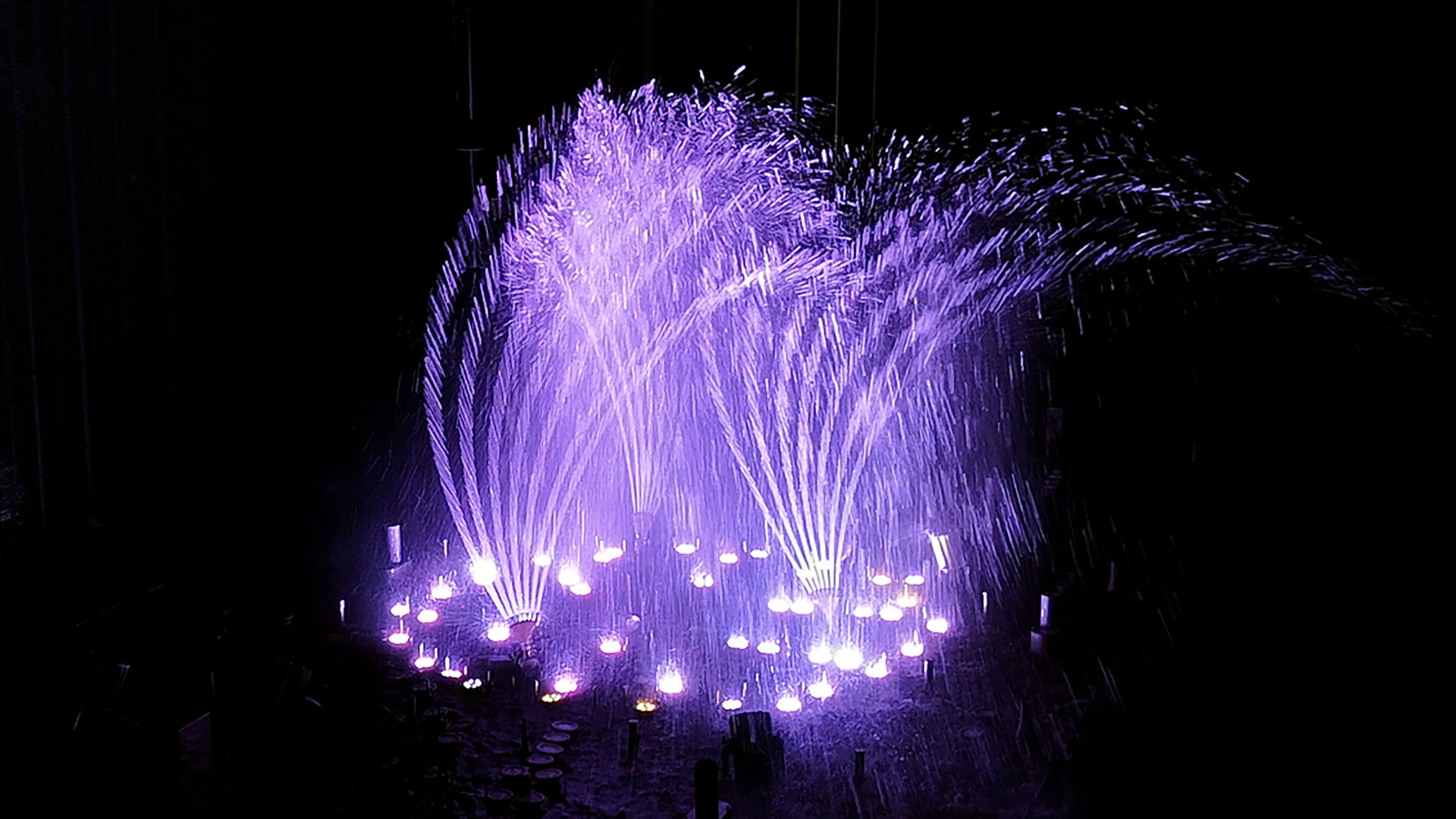
The photograph at the head of this page shows a 2D effect — interlaced fans of water drawn by dual-axis units working as a group. That group behaviour is the point: 2D units are specified in clusters, placed where the choreography needs figures, inside a wider field of simpler units.
Placing 2D Units in a Field
Dual-axis units earn their cost in feature positions: the centre of a dancing basin, the focus of a promenade feature, the cluster that performs the signature figure of the show. Surrounding them with a full field of 2D units is rarely the right spend — the eye cannot follow forty simultaneous figures, and the design stage will usually propose a mixed field in which 2D clusters carry the passages the audience watches closest.
The integrated-lighting build is listed with DMX512 control, so 2D figures are programmed on the same timeline as the 1D field, the lighting and the music. If you are upgrading an existing show, the practical question is which passages deserve figures; send the current program's weak spots — the flat middle section, the finale that never lands — and the assessment starts there.
Programming Figures: a Note on Restraint
Dual-axis units tempt programmers the way feature jets tempt designers: the vocabulary is rich, so every passage begs to use all of it. Resist. A circle drawn constantly is wallpaper; a circle drawn at the chorus, after a verse of honest 1D waves, is an event. The 2D cluster's figures should be budgeted across the program like solos — placed, spaced and rested — and the test of good 2D programming is how much of the show the cluster spends deliberately still.
There is a mechanical echo of the same wisdom: figures are the hardest work a drive performs, and a field programmed with restraint ages more gracefully than one run at its vocabulary's limit all night. Choreography and maintenance, as usual in fountains, turn out to be the same conversation.
Slip Rings, Briefly Explained
One line in the stated details deserves a gloss for buyers comparing units: the slip ring is the rotary electrical connection that lets a continuously rotating axis carry power and signal without winding its cables into a knot. The internal and external design variants differ in how that connection is packaged and protected. What matters to the project is simpler — a 360° axis that can actually keep turning, show after show, which is the entire premise of the figures this family exists to draw.
2D Swing Nozzle Questions
What can a 2D unit draw that a 1D cannot?
Closed and crossing figures: circles, waves travelling in two dimensions, and intersections between paired jets. A 1D field sways beautifully but cannot close a circle.
Do 2D units need different control?
No — the family's integrated variants are listed with DMX512 control, so integrated 1D, 2D and 3D units share one timeline and one programming discipline.
How many 2D units does a show need?
Fewer than instinct suggests. Feature clusters in the watched positions outperform a uniform field; the design stage sizes the cluster against your basin and program.