1D, 2D and 3D Fountain Jets: What the Axes Change
The motion-jet families are named by their axes, and the axes are best understood as vocabulary: one axis gives a jet a sway, two give it figures, three give it a solo. This comparison is about what each can say — specifications live on the product pages.
- Motion families compared
- Buying guidance
One Axis: the Language of Waves
A 1D unit swings its jet on a single axis. Alone, that is a lean left, a lean right. In a field — dozens of units along a basin, each offset in time — it becomes the travelling wave, the chase, the slow collective sway that forms the body of almost every musical fountain show ever performed. The 1D field is not the budget option in the motion family; it is the rhythm section, and shows are built on it the way music is built on rhythm.
Its choreography is linear and architectural: patterns travel along lines and rings, answer across the basin, build in unison. For venues whose shows are large-scale and audience-distant — lakes, landmark basins — the 1D vocabulary is not a limitation at all, because figures drawn small would not read anyway. The specification details for the 1D units, including their connection sizes and integrated variants, are stated on the 1D product page; here the point is the language: waves, chases, sways, unisons.
Two Axes: the Language of Figures
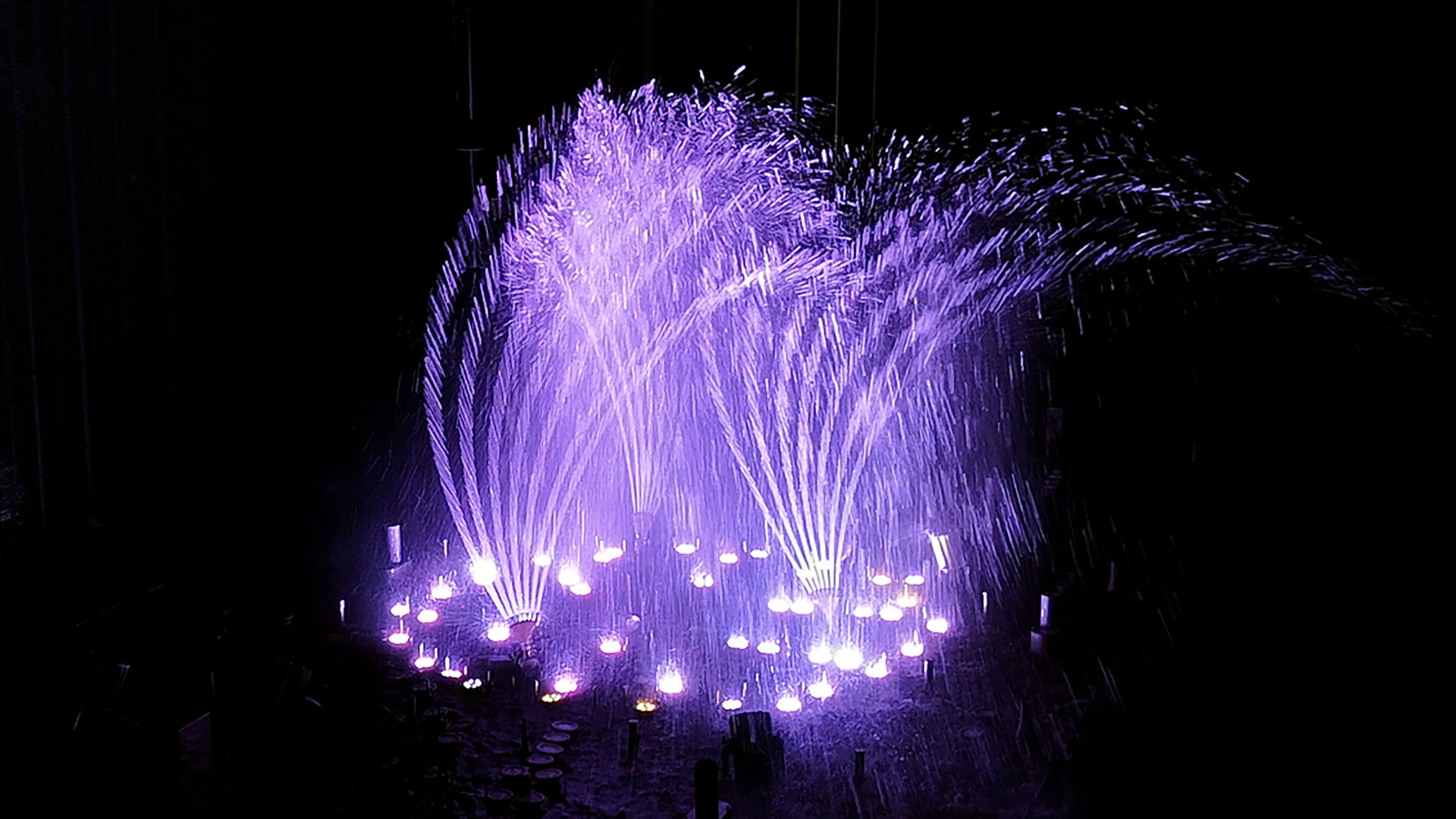
A 2D unit moves on two axes at once, and the jet starts to draw: circles that close, waves that travel diagonally, patterns that cross mid-air when pairs of units intersect their streams. Where the 1D field speaks in lines, the 2D cluster speaks in figures — and figures are what close audiences, the dancing-fountain audience above all, actually watch. The photograph at the head of the motion category shows a 2D group effect: interlaced fans that no single-axis field can produce.
| Family | Choreographic vocabulary | Where it earns its place |
|---|---|---|
| 1D swing | Waves, chases, sways, unison movement along lines and rings | The field body of musical shows; large and distant audiences |
| 2D swing | Circles, crossings, travelling figures, interlaced fans | Feature clusters in dancing fountains; close and mid-range audiences |
| 3D nozzle | Spirals, revolving figures, solo performance movement | A single watched position: centre feature, entrance focus |
The counting instinct — if two axes draw figures, a full field of them must be forty times as good — is the family's classic buying mistake. Figures compete. A field in which every unit draws simultaneously is visual noise at premium prices. Professional fields are mixed: the 1D body carries the show's minutes, 2D clusters are placed where eyes gather, and the figures are spent like solos in a band arrangement.
Specifying a Mixed Field: a Walked Example
Close with the method applied. Imagine a mid-size dancing fountain for a retail promenade: an audience at close range, an evening program, a client whose instinct is to fill the basin with the most capable units the budget reaches. The catalogue instinct buys a uniform field of mid-axis units and a show in which every passage looks like every other — competent, expensive and strangely tiring, because the eye is given figures without rhythm to rest between them.
The vocabulary method spends the same budget in layers. The field's body — the long edges and the background ring — is 1D: waves and chases that carry the program's minutes and give the promenade its constant, musical motion. Two 2D clusters sit where the promenade pauses: at the entrance court and the café bend, the two places a crowd actually gathers, drawing their circles and crossings for the people close enough to read them. And at the basin's visual centre, where the mall's axis terminates, a single 3D unit owns the finale of each program — still for most of the evening, unmistakable when it moves.
Programmed that way, the field has grammar: rhythm, incident and climax, in the proportions music itself uses. The specification conversation that produced it never asked 'how many axes can we afford?' It asked where the audience stands, what each passage of the show should feel like, and which vocabulary speaks at that distance. Ask those questions of any motion-jet proposal — including the ones on this site — and the axes will sort themselves. The product pages state each family's configuration for the specifying that follows; this article's whole argument is that the specifying should follow the choreography, never lead it.
One Sentence to Specify By
If the whole comparison must compress into a single working rule, take this one: buy the least vocabulary that says what your show means, in the places your audience actually watches, and spend the difference on programming. It will occasionally argue you out of a beautiful unit. It will never argue you into a boring show — because shows are boring from sameness, not from simplicity, and a rhythm section played with conviction has carried more great evenings than a warehouse of soloists ever will.
And When in Doubt, Watch a Show
Specifications end; judgement begins at the water's edge. Before a major motion-jet purchase, stand in front of a working field at your audience's distance and watch a full program rather than a demonstration. Demonstrations show vocabulary; programs show taste. The distinction this article has drawn — rhythm, figure, solo — will be audible in the water within ten minutes, and it will tell you more about the field you are buying than any axis count printed beside it.
Three Axes: the Language of the Solo
A 3D unit controls three axes independently and rotates its nozzle head through a full circle. Its jet can lean, sweep and spin in combination, tracing spirals and revolving figures that a field cannot imitate — not a pattern but a performance. The correct mental model is a soloist: astonishing in its passage, wrong as a choir. One 3D unit at the watched centre of a dancing basin, or a small symmetric group in a large one, is the standard placement; the product page states the unit's configuration, and the design conversation is almost entirely about restraint.
Programming decides whether the soloist sings. A 3D unit cued constantly becomes a gimmick the audience tires of within one evening; cued at the peaks, against a quieter field, it becomes the movement visitors film, describe and return for. When a brief asks for several 3D units 'for impact', the honest design answer is usually one, better programmed.
Across all three families the control discipline is shared — the motion systems run on a common show timeline — so mixing families costs no integration pain. The buying order that respects the vocabulary is: build the rhythm section first, place the figures where eyes gather, crown it with a soloist only if the venue has a true centre. Axes are cheap to admire and expensive to waste; vocabulary is what the audience takes home.
Request a Fountain Quotation
Each unit page states its own configuration — read them after this choreography comparison.