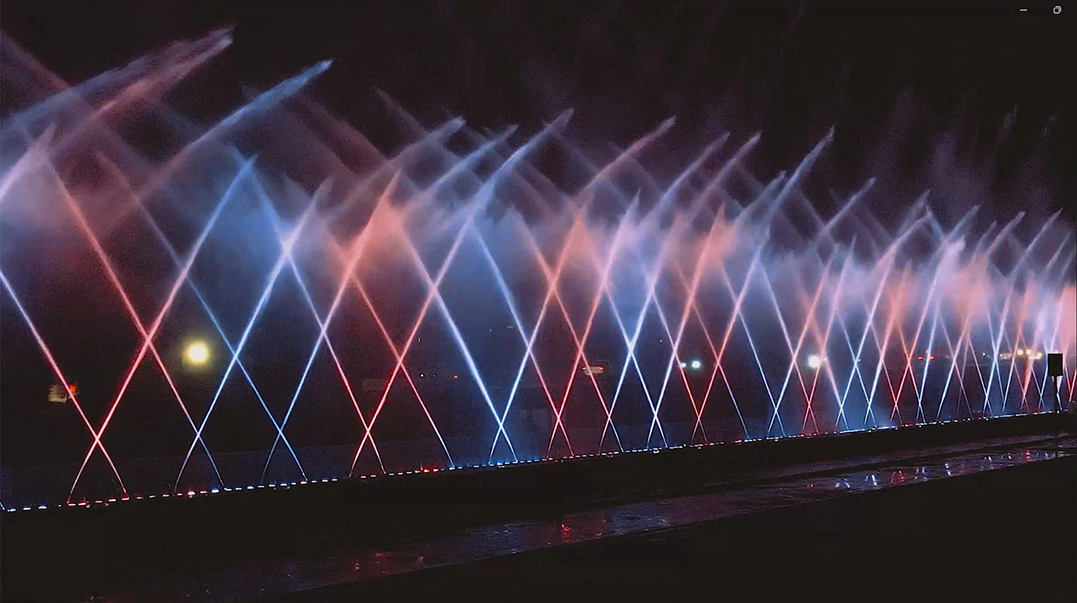
Laminar Jet Fountain
A laminar jet throws water so smoothly that the arc looks solid — a glass rod of water you can follow with your eye from nozzle to landing. It is the quiet voice in the fountain's vocabulary, and often the most loved.
- Glass-smooth arcs
- Quiet zones
- Close-range detail
Laminar Jets: Water That Behaves Like Glass
Laminar flow is water moving without turbulence, and a laminar jet keeps that order in the air: the stream leaves the nozzle as a coherent rod, arcs cleanly, and lands with barely a splash. Lit from the base, the rod carries light along its length like a fibre. The effect is precise rather than powerful — which is exactly its role in a musical fountain's effect library, where laminar arcs form the calm borders and quiet passages that let the feature moments land.
The company's product information lists laminar and jumping jets among its effect families for project-specific layouts, and that phrase — project-specific — is the honest core of laminar design. Arc length, height and spacing are set against the basin geometry and the audience's distance; a laminar rod reads at arm's length, so it belongs at edges, entrances and crossings where people pass close.
| Design element | Laminar handling |
|---|---|
| Water behaviour | Coherent, splash-light arc; sensitive to wind and supply turbulence |
| Placement | Basin edges, entrance features, crossings and quiet effect zones |
| Lighting | Base-lit arcs carry colour along the rod; a signature night effect |
| Pairing | Borders for feature zones; calm passages inside musical choreography |
| Supply note | Smooth supply conditions are part of the design; turbulence breaks the rod |
Designing With a Quiet Effect
Laminar arcs fail in predictable ways when they are treated as decoration rather than design: placed in wind, where the rod shreds; fed by a turbulent supply, where it leaves the nozzle already broken; stretched too long, where gravity wins early. The design stage avoids all three by matching arc geometry to the site and the supply — shorter, sheltered, well-fed arcs that stay glassy through the whole performance.
Used well, laminar work changes how a whole show feels. It gives the choreography a resting register, frames the feature zones, and gives close audiences — children at a basin edge, guests crossing a hotel court — a detail built for their distance. Pair it with its sibling effect, the jumping jet, and the same arc learns to move: the jumping page explains the segmented version.
Laminar Work Inside a Musical Program
Inside a full musical program, laminar arcs do the work that rests an audience: the quiet verse under which the feature rests, the border that keeps the eye inside the composition, the prelude that teaches the crowd the show has begun gently. Programmers protect these passages. A show that opens at full voice has nowhere to build, and the laminar register is where the building starts.
That is also why laminar quality is a system property rather than a fitting property. The arc stays glassy only when the whole chain — supply smoothness, nozzle condition, placement shelter — is maintained together, which is why the maintenance checklist on this site gives laminar exits their own inspection line. Beauty this quiet is an operational achievement, renewed monthly.
Laminar Jet Questions
Can you touch a laminar arc?
At the edges of interactive spaces, laminar arcs are often placed within reach and are a favourite play detail — placement and supply are designed for it where the brief asks.
Why does a laminar jet sometimes look rough?
Turbulence in the supply or wind across the arc. Both are design-stage items: supply conditioning and sheltered placement keep the rod coherent.
Does laminar work outdoors?
Yes, in geometries matched to exposure. Sheltered and shorter arcs outdoors; long exposed arcs belong in calmer settings — the design review grades the site honestly.