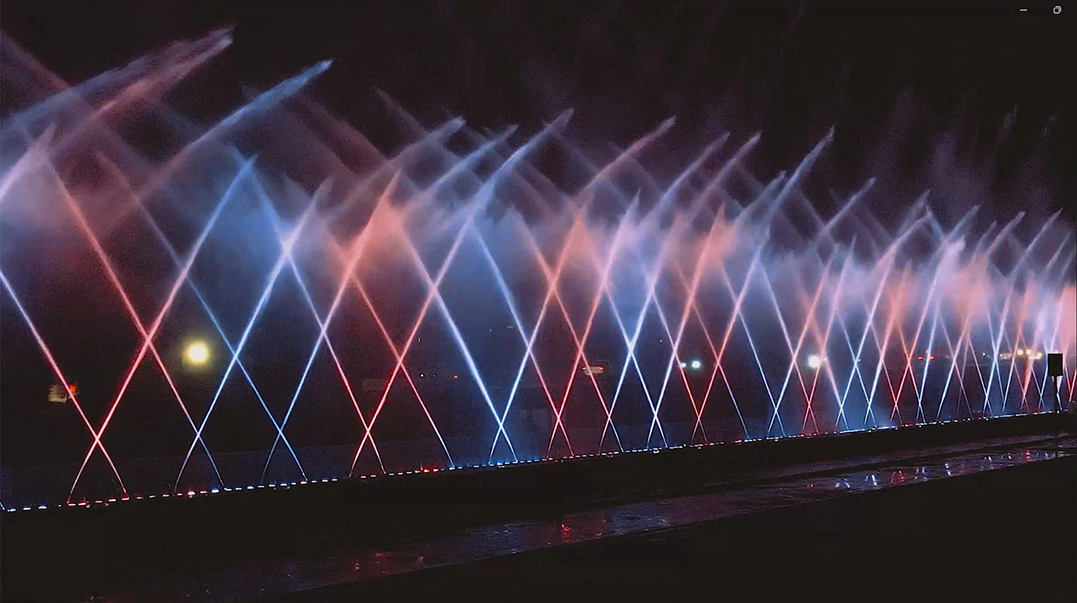
Jumping Jet Fountain
A jumping jet takes the laminar arc and cuts it into segments — distinct rods of water that leap from the nozzle, travel the arc, and land as separate pieces. Program a row of them and the segments chase each other across the basin.
- Segmented arcs
- Chase sequences
- Playful movement
Jumping Jets: the Arc, Taught to Dance
The jumping effect is a timing trick played on laminar water. The arc itself is the same coherent rod its laminar sibling throws; a fast cutting action divides it into segments in flight, so the audience sees separate loaves of water hopping along the arc's path. One unit is a curiosity. A programmed line of them — segments chasing, answering, racing — is a small performance that works at any scale of fountain and delights at every age.
Jumping jets sit in the company's laminar and jumping jet effect family, specified for project-specific layouts. Their natural homes are the animated edges of a show: borders that should not sit still, crossings where segments hop over walkways between basin sections, play-adjacent zones in family venues, and the lively passages inside a musical program where the choreography wants wit rather than grandeur.
| Design element | Jumping handling |
|---|---|
| Effect | Laminar arc divided into travelling segments by timed cutting |
| Programming | Chase, answer and race sequences across a line of units |
| Placement | Basin borders, crossings, play-adjacent zones, animated edges |
| Audience | Close-range effect; rewards viewers near the water |
| Pairing | Continuous laminar arcs for contrast; feature zones for peaks |
Timing Is the Whole Effect
A jumping jet stands or falls on the precision of its cut. Segments must be clean — a ragged cut throws spray, not loaves — and the sequence timing across a line of units must be exact, or the chase reads as noise. That is why the effect is specified and commissioned as part of the control program, not bought as a novelty fitting: the program is where the hopping rhythm lives.
In the design stage, jumping lines are drawn against the basin plan like musical phrases — where the chase starts, where it answers, where it rests. Combined with the stillness of continuous laminar arcs beside them, the contrast does the entertaining. If your project has a border, a crossing or a family zone that needs movement at human scale, this is the effect family to brief.
Jumping Jets in Dry Deck Layouts
Ground-level layouts give the jumping effect a second career. Set flush units in a line across a plaza's play zone and the segments hop along the paving itself, appearing from the stone and vanishing into it — an effect children read instantly as a game with rules they can learn: where the next segment lands, how long the pause lasts, which line is winning the chase. The programming writes those rules; the paving keeps the secret of the machinery.
In dry layouts the drainage design and the effect design are the same drawing, because every landed segment is water the surface must return without ponding. That is one more reason the effect belongs inside a designed system rather than in a crate of fittings: the hop is easy to buy and surprisingly easy to install badly.
Jumping Jet Questions
How is a jumping jet different from a laminar jet?
Same arc, divided. A laminar jet throws a continuous rod; a jumping jet cuts the rod into segments that travel separately. Many layouts use both side by side.
Can jumping jets work in a dry deck?
The effect suits ground-level layouts where segments hop between flush nozzles — a favourite in family and play-adjacent designs. Layout is confirmed per project in design.
Is it a musical fountain effect or a play effect?
Both. Inside a musical program it is a witty mid-register voice; in play settings it is simply the most watchable water in the field.