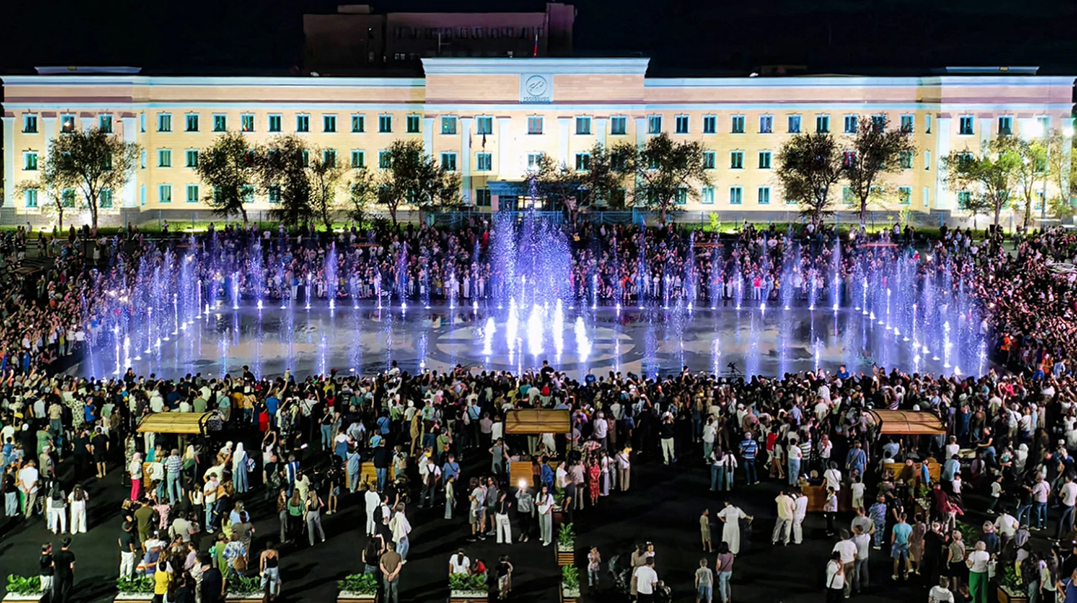
Baikonur Dry Deck Fountain — Lenin Square, Kazakhstan
Project reference shown by the company: a dry deck musical fountain at Lenin Square in Baikonur, Kazakhstan — the civic format at full scale, on a square that hosts ceremonies when the water is off.
- Civic square
- Dry deck musical format
- Company project reference
The Baikonur Reference in the Company's Own Description
Baikonur, Kazakhstan — project reference shown by the company. The installation at Lenin Square is a dry deck fountain, described by the company as a 40 m × 20 m musical fountain, covering the design and construction of the project. The figure is the company's own description, and it belongs to this project alone.
The photograph tells the format's story better than any specification: a full crowd standing in the jet field's square at night, the water performing in programmed patterns between them, and a formal civic building as the backdrop. Hours earlier the same paving was a square. That reversibility — performance without permanent occupation — is the entire reason the dry deck format exists, and Baikonur is the reference that proves it at civic rather than decorative scale.
What a Civic Brief Takes From This Reference
Three transferable decisions. First, format honesty: the square kept its civic job — ceremonies, gatherings, daily crossings — and the fountain was required to disappear into it, which is why the plant is underground and the surface is paving. Second, program range: a dry deck musical fountain runs gentle daytime patterns and a full evening show from the same field, so the square's programming office, not the equipment, decides what kind of day the square is having. Third, crowd geometry: the jet field was laid out for a standing crowd within it, which changes spacing, pressures and drainage compared with a watched basin.
If your square resembles this one — formal, multi-use, politically visible — the dry deck family page and the dry-versus-wet comparison guide are the two reads that precede a brief. Bring the square's events calendar to the design review; in civic work it is as important as the site plan.
Ceremonies First: Reading the Civic Brief
The order of priorities in this reference deserves emphasis, because it inverts the usual fountain brief. The square's ceremonial function was not a constraint the fountain negotiated with; it was the client. The fountain's job was to add a second life to the square without taxing the first — no footprint, no fencing, no visual argument with the building behind it. Every technical property of the dry deck format serves that order of priorities, which is why the format, rather than a basin with better manners, was the answer.
Civic buyers elsewhere should steal the brief's structure even more than its format: name the square's existing duties first, in writing, with the people who run them in the room. A fountain designed under that discipline arrives as a citizen. A fountain designed around it arrives as an occupation, and cities eventually vote occupations out.
Baikonur Reference Questions
Can a square really host ceremonies over a fountain?
That is the format's defining property: off, the installation is flush paving with nothing above ground. The Baikonur reference is a working civic square, not a fenced attraction.
Is the 40 m × 20 m size a standard product?
No. It is the company's description of this project. Dry deck fields are sized to the square and the program, in the design stage.
Does a dry deck musical fountain need a stage or backdrop?
No — the Lenin Square building is the square's own architecture. The show is programmed for viewing in the round within the field itself.