Dry Deck or Wet Basin? A Practical Comparison
The most consequential early decision in a plaza fountain project is not the equipment — it is whether the water lives in a visible basin or under the paving. This comparison works through the factors that should decide it.
- Format decision
- Factor comparison
- Selection checklist
Dry Deck or Wet Basin? A Practical Comparison
A wet fountain — the traditional basin — keeps its water visible: a permanent water surface with jets, watched from its edges. A dry deck fountain hides its reservoir below ground and performs through flush nozzles in the paving, on a surface the public walks across. Both run the same choreography and control; both can carry a full musical program. Everything else about them — how the space lives, who the audience is, what maintenance means — diverges.
| Factor | Wet basin fountain | Dry deck fountain |
|---|---|---|
| Space when off | Basin remains a water feature; edges fenced or designed as seating | Surface returns fully to plaza use — markets, ceremonies, crossings |
| Audience position | Watching from the edge, in the round | Inside the field; play is part of the format |
| Show scale | Full concert format; feature heights over open water | Musical shows at ground level; scale read through pattern and light |
| Public contact | Water is looked at, not entered | Designed for contact: pressures, drainage and treatment set for play |
| Civil works | Basin structure and waterproofing | Underground reservoir and plant beneath the paving |
| Best suited to | Landmark squares, lakes and resorts with a dedicated water area | Multi-use plazas, forecourts, family venues, ceremonial squares |
The Questions That Actually Decide It
Work through four questions in order. First: what must the space do when the fountain is off? If the answer involves markets, ceremonies or heavy crossings, the dry deck is the only honest candidate. Second: who is the audience — watchers or participants? Families who should play in the water argue for dry deck; an evening crowd gathered for a concert argues for a basin. Third: what backdrop and scale does the show need? Feature height and multimedia layers favour open water. Fourth: what does your operations team maintain better — a visible basin's water, or a hidden plant room under a working plaza?
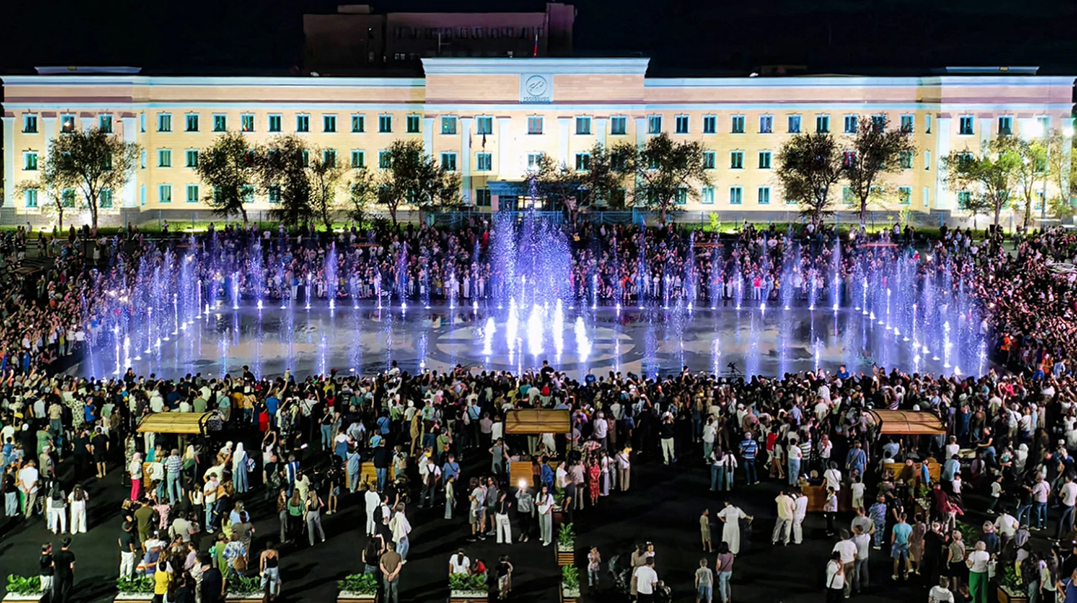
Mixed answers produce mixed formats, which are legitimate: a basin show with a dry deck play apron, a dry field with a small feature pool. The design review exists to compose those answers for a specific site — the Baikonur reference is a dry deck that took the musical-spectacle side of its brief seriously, and the plaza musical page describes the basin answer at the same civic scale.
When the Answer Is Neither — and When It Is Both
Some sites dissolve the comparison entirely. A lakeside venue may skip both formats for a floating system on the water it already has. A heritage square may take a dry floor field — the format detailed on the dry floor fountain page — precisely because its off-state is indistinguishable from the square itself. And hybrid compositions are legitimate professional work: a basin show for the evening crowd with a dry play apron at its edge for the daytime one.
The comparison's purpose is not to crown a winner but to force the four questions — off-state, audience, backdrop, operations — into the open before concrete makes the answers permanent. Bring the answers, marked honestly, and the format usually names itself.
Selection Checklist
- Space must host non-fountain events → lean dry deck
- Audience should enter the water → dry deck
- Show needs feature height or a water screen → lean wet basin (or open water)
- Evening concert crowd is the headline → lean wet basin
- Heritage or ceremonial square that must read 'empty' by day → dry deck
- Resort or lakeside site with water already present → consider floating instead of both
Still split? Send the site plan with your answers marked. A format recommendation with reasoning costs one design review and prevents the most expensive change of mind in fountain projects — the one that happens after the concrete.