What Is a Water Screen Movie?
A water screen movie projects film onto a fan of water, so the image hovers over a lake or basin and dissolves back into it. It is the strangest screen in the events industry — and, understood properly, one of the most practical.
- Format explained
- Multimedia shows
The Screen Is Water, Formed on Purpose
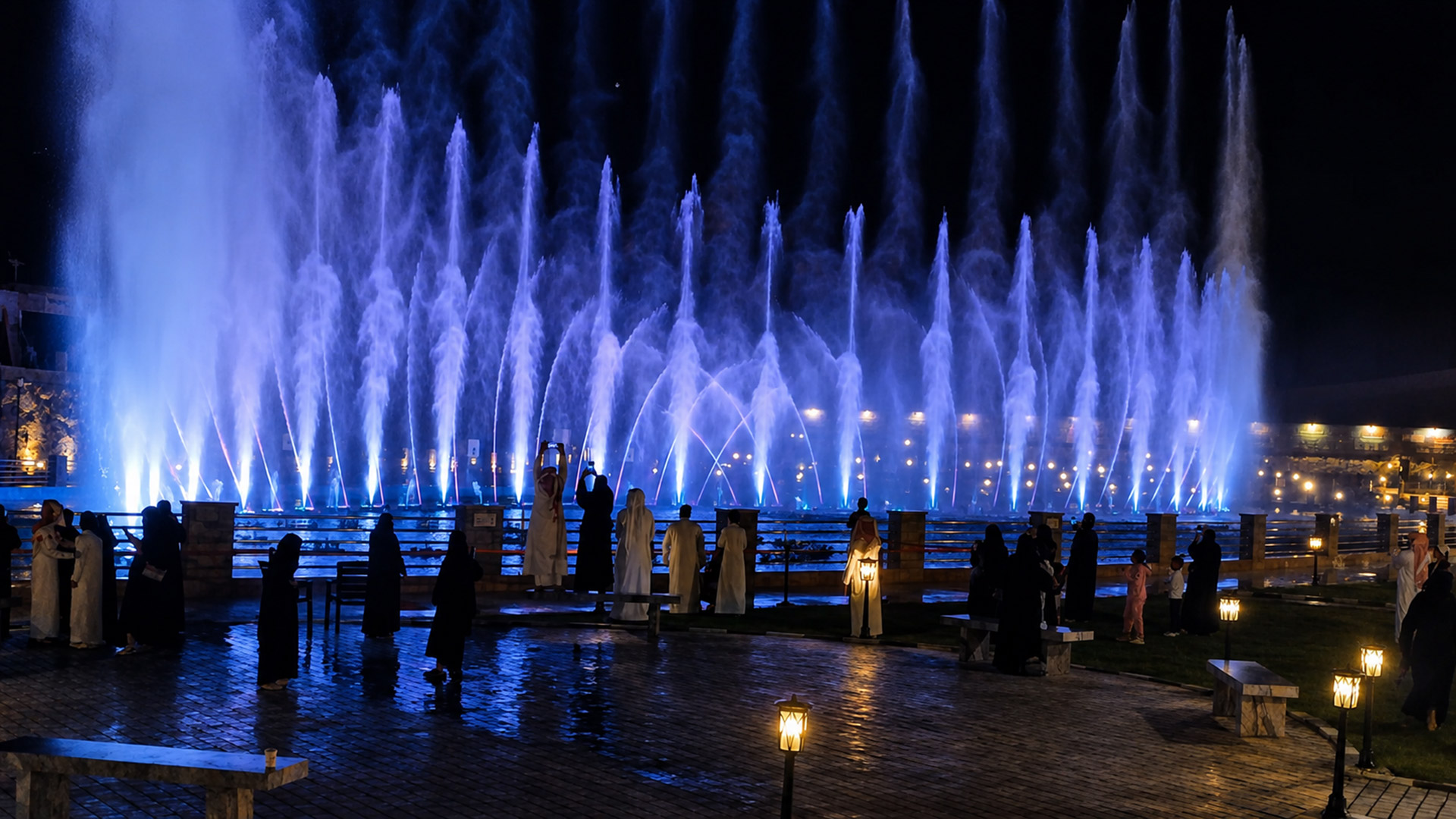
A water screen begins as fountain engineering. Dedicated nozzles throw water into a thin, fan-shaped sheet — wide, tall and as even as the water supply can make it. From the front, lit only by ambient light, it is a shimmering veil. Then a projector behind or before it throws an image, and the sheet becomes a surface: the droplets scatter the projected light toward the audience, and a picture assembles itself out of falling water.
The image has a quality no rigid screen offers. It is translucent — the venue's lights and the night sky show faintly through it. Its edges are weather, softening and breathing. And when the segment ends and the nozzles close, the cinema is simply gone: no structure stands over the water in daylight, nothing needs storing, and the basin returns to being a fountain. Venues that could never host a permanent screen — heritage squares, resort lakes, festival waterfronts — can host this one for exactly the length of a show.
That ephemerality is why the format is programmed, not installed. A water screen exists as an act inside a show: the choreography builds, the screen rises, the film plays, the screen falls, the water dances on. Treating it as a permanent outdoor television misunderstands it; treating it as the multimedia act in a night program is exactly right.
What Decides Whether the Picture Works
Four variables govern the image, and honest suppliers discuss all four before equipment. Darkness first: a water screen competes with every light in the venue, and promenade lighting that nobody budgeted as a problem can halve the picture. Projector geometry second: throw distance, angle and protected positions for the machines, with the image sized to the screen the water can actually form. Screen size third — set by audience distance and water supply, not by ambition; an over-large screen thins, tears in wind and loses more picture than a smaller, denser one keeps. Content fourth: film prepared for the screen's proportions and translucency, with bold imagery that survives being made of weather.
Wind deserves its own sentence, because it is the variable brochures omit. A water sheet is a sail made of droplets; a gusty night moves and thins it. Professional programs treat screen segments as the weather-sensitive act they are — placed within the show so the evening survives their shortening, and specified with the site's real exposure in the assessment, not its calmest evening.
None of this makes the format fragile. It makes it a designed act, like a firework segment or an aerial performance: conditions assessed, content prepared, expectations honest. Water screens have carried national celebrations and festival centrepieces precisely because their producers respected the four variables.
The Producer's Checklist
For venue teams assessing a water screen segment, the whole article compresses into a producer's checklist — the questions to work through, in order, before anyone discusses equipment. First, the audience: how many, how far, at what angle to the intended screen, and what else competes for their eyes at that hour. Second, the darkness: a site visit at show time with a light meter's honesty, listing every source that will wash the image, and a decision about which of them the venue can dim, shield or schedule around.
Third, the geometry: candidate screen positions against the water available, projector positions with real throw distances and weather protection, and the power and data runs both imply. Fourth, the content: what will actually be shown in month one and month twelve, who produces it, and whether it is being made for a water screen's proportions and translucency or merely lent by a cinema library. Fifth, the weather plan: the wind conditions in which segments shorten, move or yield to pure choreography, and who calls that decision on the night.
A proposal that answers all five before pricing has understood the format. A proposal that prices first and discovers the checklist later will teach it to you at production prices. Water screens are generous to prepared producers — the image that rises out of a lake and holds a crowd silent is among the great bargains in live spectacle — but they are strict teachers of the unprepared. Work the list, in order, and the strangeness of the medium becomes its reliability.
Why the Format Keeps Returning
Water screens have been declared novelties for decades, and they keep returning to the world's serious celebrations — because they solve a permanent problem in a way nothing else does. Venues need, a few nights a year, to say something enormous in a place where nothing enormous may be built. A screen that assembles from water, speaks, and dissolves back into the fountain leaves the heritage square, the resort lake and the festival waterfront exactly as it found them, with the crowd carrying the image home in memory and on their phones. Permanence is not the only form of impact; for the right nights, it is not even the strongest one.
One Practical Starting Point
If the format tempts you, start smaller than your imagination: one screen segment inside one evening program, on one well-chosen night, produced properly rather than grandly. A single honest sequence — the founders' faces over the harbour, the new building rising out of its own lake — teaches a venue more about its audience, its darkness and its content pipeline than a season of renderings. The medium scales by repertoire, not by debut size.
Where Water Screens Earn Their Place
The format earns its production cost where content is the point: a festival that must tell a story on its waterfront, a national day program with a film at its heart, a resort show that renews its program with the seasons because the content is a file, not a structure. Combined formats are the pattern — the Valley Resort reference on this site pairs its dancing fountain with water screen and laser effects, which is the standard professional stack: choreography for the body of the evening, screen for the content, laser for scale and punctuation.
Where the brief is atmosphere rather than content — a beautiful place made more beautiful nightly — a musical fountain with strong lighting usually serves better and cheaper, and a good design review will say so. The water screen is not the deluxe version of a fountain; it is a different instrument, for venues whose evenings have something to say.
If your venue has something to say, the briefing inputs are simple: the venue plan with audience positions, the ambient light situation at night, where projectors could stand, and the content you imagine showing. Geometry and feasibility come back from the design stage; enthusiasm, you bring yourself.
Request a Fountain Quotation
The projection system page takes the screen, throw and playback apart piece by piece.