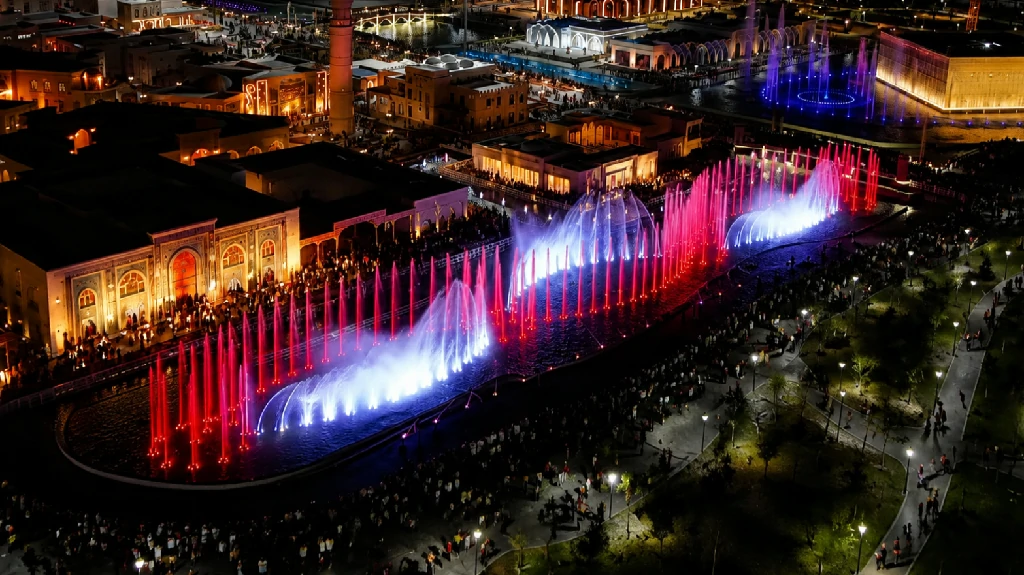
How Musical Fountains Sync Water, Music and Light
Audiences describe a good musical fountain as 'perfectly in time'. That precision is not a talent of the water — it is a structure: zones, two control layers, and cues written by someone who understands that a jet answers late and light answers instantly.
- Choreography explained
- Control & cues
The Short Answer: One Timeline, Many Delays
A musical fountain show is a single timeline of cues. On that timeline sit three families of events — water movements, lighting changes and musical moments — and the craft of synchronisation is knowing that the three families do not respond at the same speed. A lighting cue lands the instant it is sent. A swing nozzle needs a breath to travel to its angle. A pump-driven jet needs longer still: pressure builds, the column rises, and the water you see at the musical peak left the nozzle measurably earlier. The programmer's job is to fire every cue early by exactly its equipment's delay, so that what the audience perceives — water, light and note — arrives together.
That is the whole secret, and it explains most of what separates a convincing show from a fountain that merely plays music nearby. When water appears to chase the beat instead of meeting it, nobody forgot the music; somebody forgot the delays. When the lighting and the feature jet peak together and the crowd makes the small satisfied noise crowds make, a programmer somewhere counted correctly.
Effect Zones: the Units Choreography Thinks In
No programmer cues hundreds of individual devices across a whole show. The basin is divided into effect zones — the centre feature, a swing field, a perimeter ring, a water screen area — and each zone is an instrument with its own pumps, valves, motion units and lighting circuits. A cue addresses a zone: 'swing field, travelling wave, building over eight counts'. Inside the zone, the control system distributes the instruction to its units with their individual offsets, so the wave actually travels instead of merely starting everywhere at once.
Zone design is therefore choreography design. Zones drawn too large make a blunt show — everything moves, nothing means anything. Zones drawn too small drown the programmer in bookkeeping and the audience in noise. The design stage draws zones against the music the venue actually wants: broad zones for broad, architectural numbers; a fine-grained centre for the passages where a solo motion unit performs. It is also why retrofits disappoint when the zones are wrong — no program, however clever, can divide a field the hardware treats as one piece.
The same zoning logic governs the lighting. Fixtures are addressed individually or in zones on the DMX timeline, which lets colour chase along a ring in step with a water chase, or hold a wash steady while the water moves — contrast being as much a choreographic tool as synchronisation itself.
Two Control Layers, Two Different Jobs
Under the show timeline sit two control layers that should never be confused. The PLC layer runs the plant: pumps, valves, water levels, filtration and safety interlocks. It is industrial, conservative and always on duty, whether the evening's show is a gala program or a quiet Tuesday pattern. The DMX layer runs the performance: motion nozzles, lighting and effects addressed as show data. It is expressive, dense and concerned with milliseconds of perceived timing.
Keeping the layers distinct is what makes a fountain both safe and artistic. The show layer can demand anything the music suggests; the plant layer grants what the machinery can honestly give, and protects the equipment when the two disagree. When a system is offered with 'PLC and DMX control', this division is what the phrase means — and when a supplier cannot explain which layer does what, the explanation gap usually reappears later as an operational one.
Control architecture is product-specific, and the timeline discipline described here is what any stated control basis must ultimately serve. The principle survives every variant, though: something trustworthy runs the plant, something expressive runs the show, and the program is written where the two meet.
A Worked Example: One Chorus, Three Families
Make it concrete. A chorus begins: the music swells over eight bars toward a peak everyone in the crowd can feel coming. The programmer's map spends those bars deliberately. The perimeter ring opens with a colour wash two bars early — light is instant, so its cue sits almost on the beat, warming the scene. The swing field begins its travelling wave a full bar ahead of the swell's midpoint; the wave needs travel time, and its units were fired early by their measured offsets so the wave's crest, not its start, meets the music's rise. The laminar borders stay lit and still — contrast is a cue too.
At the peak, the centre feature fires. Its cue left the control system earliest of all, because a high jet is the slowest voice in the fountain: pressure, rise, the column's full height arriving a perceptible moment after the command. Timed honestly, the column tops out exactly as the music does, lit from below by a fixture cue that waited until the last fraction — light can afford to wait; water cannot. Then the air-explosion accent lands on the downbeat after, a punctuation mark the crowd feels in the chest.
Now run the same chorus with every cue fired naively on its musical moment. The wash is right; the wave arrives a bar late and reads as an echo; the feature jet crowns after the peak has passed, apologising; the accent lands inside the next phrase like a dropped glass. Nothing in the equipment changed. The delays were simply never paid — which is why this article insists that synchronisation is accounting before it is art, and why commissioning watches choruses, not components.
Writing Cues: Where Shows Are Actually Made
Cue writing begins from the music's structure, not from the equipment list. The programmer maps the piece: where it builds, where it breathes, where the peak must land. Feature moments — the rotating crown, the flame accent, the air-explosion burst — are spent like a budget across that map, because a show at maximum intensity for ten minutes has no peaks at all. Quiet passages get the laminar borders and the colour washes; the swing field carries the verses; the centre feature is saved for the moments the audience will describe afterwards.
Then the delays are paid. Each zone's cues are offset by its measured response, the offsets are verified on real water during commissioning, and the show is watched from the audience's positions and adjusted — tempo nudged, a chase re-timed, a lighting cue moved two frames earlier because the eye forgives light differently from water. This is why commissioning on site matters: synchronisation cannot be finished in a simulation, only prepared there. The simulation proves the choreography; the water itself grades the timing.
It is also why a fountain's later life is so programmable. New music means a new cue map on the same zones; a festival variant means re-spending the same feature budget in a different shape. The hardware's job is to stay honest and responsive for years; the program's job is to keep giving the audience a reason to stay for one more song.
Request a Fountain Quotation
Zones, control layers and cue craft — the musical fountain pages show the hardware side of this article.