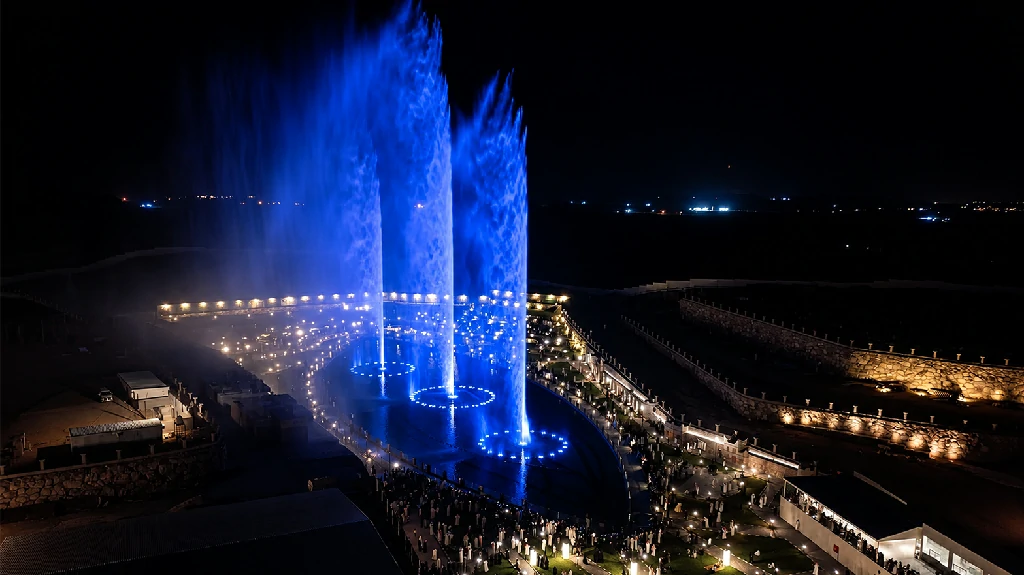
Floating Fountains for Lakes: What the Format Buys You
A lake is the one site where building a fountain basin makes no sense — the water is already there, at a scale no basin matches. The floating format takes the show to the water. Here is what that buys, and what it asks in return.
- Lake format
- Planning questions
The Problems Floating Solves
Start with what a lake project would otherwise require: cofferdams or drained sections, a basin structure built in a living water body, environmental permissions for permanent construction in the water, and a construction season measured against weather and water levels. A floating fountain deletes nearly all of it. The system arrives as a manufactured platform — pumps, nozzles, lighting and control integrated on one structure — is floated into position, moored, connected to a shore supply, and commissioned on the water.
It also buys reversibility, which lake owners value more than they expect. A floating installation can be repositioned as a venue's use changes, hauled for major servicing, or removed entirely leaving the lake as it was. And it buys scale economics: the cost of the show grows with the platform and program, not with cubic metres of basin, so a large water body stops being a construction problem and becomes the asset it always looked like.
Resorts grasp this first — a lake show visible from every terrace, installed without draining the lake the guests came for — but municipal reservoirs, park lakes and waterfront developments work through the same arithmetic and reach the same answer.
What It Asks in Return: Mooring, Materials, Service
The format's honesty begins with mooring. A floating platform lives in moving water and moving air; its anchors must hold the show's geometry steady enough that choreography reads as designed, through level changes across seasons and the wind the site actually gets. Mooring is designed per water body — depth, bottom, exposure — and a brief that does not mention it has not yet become a serious brief.
Materials are the second charge. A floating system sits in its water permanently, and corrosion is patient. The material specification is confirmed against the water it will live in — its chemistry, its salinity, its treatment regime — because the wrong choice does not fail loudly; it fails slowly, everywhere at once. Tell your supplier your water's real chemistry, including brackish inflows, and let the material follow.
Service is the third. Somebody must reach the platform safely, routinely, in the site's real weather. Boat access, a haul-out point, safe working arrangements for electrical checks — these are designed, not improvised, and they belong in the project scope beside the platform itself. A floating show that cannot be serviced conveniently will not be serviced, and un-serviced fountains decline on a schedule everyone can set their watch by.
A Lake Brief, Written Properly
End with the practical artefact: the brief that gets a floating project quoted honestly. It fits on a page, and every line of it exists because a project somewhere suffered for its absence. Open with the water body: dimensions, depth profile with seasonal levels, inflows and water chemistry — fresh, brackish or salt — and the exposure the site actually gets, not its calmest postcard. Continue with the shore: where the audience stands and sits, the distances involved, the backdrop, and the ambient light after dark, including the promenade lighting nobody remembers to mention.
Then the operations: how service reaches the water, where a boat launches or a haul-out could happen, what shore space exists for power, control and storage, and the seasonal story — storms, ice, level extremes, the venue's own calendar of closures and festivals. Close with the program ambition in plain language: a gentle presence, a nightly show, a multimedia headline. Suppliers receiving this brief can design; suppliers receiving a photograph and the words 'something like this' can only guess, and their guesses will be priced as certainties.
The brief also protects the buyer in comparison. Three suppliers answering the same page of facts produce three designs that can be judged against each other — against your viewpoints, your chemistry, your service reality. Three suppliers answering three different silences produce three unrelated numbers and a decision made on confidence rather than fit. Floating fountains reward the prepared brief more than most formats, because the format itself removes the construction unknowns and leaves only the knowable ones: your water, your shore, your weather, your evenings. Write them down, and the lake does the rest.
The Question Behind the Questions
Underneath every section of the brief sits one question that decides whether a lake project should happen at all: does this water have an evening audience? A floating show is a performance, and performances need their public — a promenade that fills at dusk, terraces that face the water, a shore where people already linger. Where that audience exists, the format's economics sing. Where it must be invented, no platform, however elegant, can substitute for it. Answer that question honestly first, and the rest of the brief becomes what it should be: engineering in service of a crowd that is already coming.
A Closing Word on Ownership
A floating fountain changes who owns a lake's evenings. A shore that hosted a path and a view gains a programme, an audience and a reason to stay after dark — assets that compound quietly in bookings, ceremonies and civic pride. That is the return the format is really selling, and it is why the unglamorous brief matters: the show only compounds if it keeps showing up, season after season, on the water it was moored to.
Designing the Show From the Shore
A lake audience is a shoreline: promenades, beaches, terraces, a bridge. The design consequence is that lake choreography is composed wide and read at distance. Fine detail — the laminar arc's glassy perfection, small pattern work — dissolves across the water's width. Bold shapes, clear rhythmic movement, strong colour and a confident centre feature carry. The design stage models the actual viewpoints, because a show balanced from above, in a rendering, can be subtly wrong from every seat that will ever be occupied.
Lakes also offer the multimedia formats their best home. A water screen needs throw distance and darkness; a lake at night provides both, with the audience conveniently gathered on one shore. Laser segments write over open water with a scale no basin allows. Many lake briefs therefore grow from 'a fountain' into 'the evening program' — choreography as the body, screen and laser as the content layers — and the floating platform is what makes that program physically simple to host.
None of this diminishes the basin fountain, which remains the right answer where its water does not already exist. The formats are answers to different sites. The lake's question was never 'how do we build a basin here?' — it was always 'the water is already performing; how do we give it a show?'
Request a Fountain Quotation
The floating family pages carry the listed specification and the lake planning layer in full.