Dry Deck Fountain Design Basics
A dry deck fountain looks like nothing — a plaza with a secret. Its design is therefore mostly invisible too: a reservoir, a drainage fall, a jet field laid out against walking routes. Here are the basics a good design gets right.
- Design basics
- Plaza engineering
Start Below Ground: the Reservoir and Plant
Every dry deck fountain is two structures: the plaza everyone sees and the plant room nobody does. Below the paving sit the reservoir that holds the system's water, the pumps that drive the jet field, filtration and disinfection equipment, and the control. The size of that hidden structure follows the field above it — more jets, more simultaneous patterns, more water in motion at once, more plant below to serve it.
This is the first design basic because it constrains everything else and is the easiest to under-scope. A design that prices the visible field and gestures at the plant will meet its real cost in excavation. A professional design fixes the below-ground scope against the site's existing underground services — the cables, pipes and structures already buried in a working plaza — early enough that the jet field can still move to accommodate them, rather than the other way round.
Lay the Jet Field Against Walking, Not Just Geometry
On paper, jet fields want to be grids and rings. In a plaza, they must negotiate entrances, crossings, desire lines, seating edges and the routes people take in the rain when the fountain is off. The design basic is to draw the pedestrian map first and the jet map second: keep the wettest, liveliest patterns where play is welcome, keep through-routes comparatively dry, and let seating edges sit at the field's calm rim where grandparents can supervise in comfort.
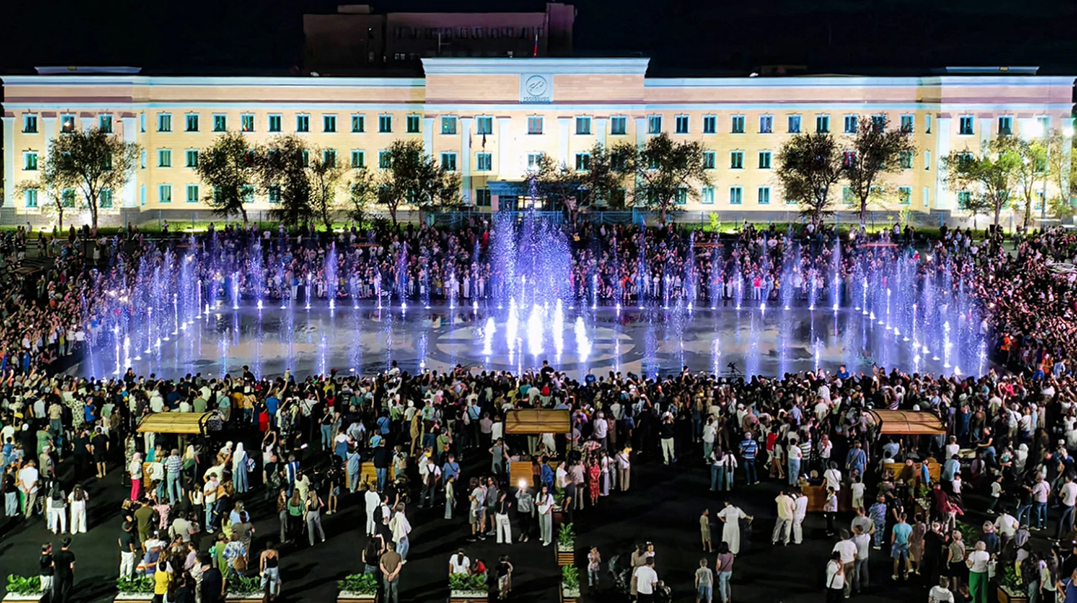
Pattern design follows the same map. A field read by passing traffic can be simple and bold; a field designed as a destination — a square's main attraction — earns layered programming: gentle crowns at the edges for the youngest children, chasing sequences in the core, and a full musical show with lighting when the evening turns the play space into a stage. One field, several publics, sequenced by the clock.
Nozzle plates sit flush in the paving and must stay that way under years of feet, frost and cleaning machines. Their specification — material, fixing, the detail where metal meets stone — is a small line in the design and a large determinant of whether the plaza still looks municipal in year ten.
Water That Falls Must Go Somewhere: Drainage and Treatment
A dry deck throws its reservoir into the air in public, continuously. Two systems make that defensible. Drainage first: the paving falls — subtly, within accessibility limits — to channels that return the water to the reservoir fast enough that the surface never ponds, because ponded water on a walking surface is a hazard and a hygiene failure at once. The falls are designed with the paving contract, not discovered by it.
Treatment second: recirculated water in a play environment is filtered and disinfected as a core function, sized for the reality of public contact — sunscreen, dust, leaves, and several hundred small feet. The design states the treatment scope plainly and the operator's routine keeps it honest. When comparing quotations, this is a section to read word by word; a dry deck quote that is vague about treatment is vague about the thing your public health officer will ask about first.
Surface safety completes the trio: jet pressures at the surface set for public contact, patterns that do not ambush the walking lanes, and a slip-aware surface strategy for wet paving. None of these limit the fun; all of them are what make the fun insurable.
The Cost of Getting the Basics Wrong
Dry deck failures are instructive because they are so rarely about the visible fountain. The first classic: a field laid out as pure geometry across a working plaza, so the morning market's stalls stand in the wettest patterns and the crossing route runs through the play core. The fountain is blamed, daily, for a drawing decision. The second: drainage falls negotiated away during paving, leaving a surface that ponds — and a ponded play surface is closed by the first inspector who walks it, converting the venue's headline attraction into its most photographed puddle.
The third failure hides below ground, where the budget was trimmed: a reservoir and treatment scope sized for the brochure's jet count rather than the program's simultaneous demand, so the liveliest sequences — the ones the venue advertises — run the water quality down by evening. The fourth is quieter still: nozzle plates that work loose under traffic because their fixing detail was value-engineered by someone who will never maintain them, leaving a plaza that trips its public one plate at a time.
Notice what these four have in common: none is a nozzle failing to jet. All four are basics — layout against walking, falls, plant sizing, fixing details — decided early and cheaply, or late and at concrete prices. That is the argument of this whole article restated as a warning: in the dry deck format, the design stage is not a preliminary to the product. The design stage, with its drains and falls and plant rooms, substantially is the product. Buy it with the seriousness that fact deserves, and the visible fountain — the part everyone photographs — takes care of itself.
A Short Note on Budgets and Blame
Notice, finally, where this article has spent its attention: almost nothing on the jets themselves. That is the format's budget truth as well. In a dry deck project the money that decides success sits in structure, drainage, plant and programming — the invisible ledger — while the visible fittings are comparatively the small change. Quotes should be read in that proportion. A dry deck proposal whose detail lives in its nozzle photography and whose underground scope fits in a paragraph is telling you, in advance, exactly how the project will go.
Program the Square's Whole Day
The last basic is programming, because a dry deck is a venue, not an appliance. A considered daily arc might run: dry for the morning market set-up, gentle play patterns through the school-run hours, the lively sequences for the afternoon crowd, a rest while the square hosts a ceremony, then the evening musical show with lighting as the square's headline. Each state is a program on the same control system; the design work is deciding the arc with the square's operators before the field is built, so zones and field layout serve the day's shape.
Get these basics right and the format delivers its famous trick — a square that is two places in one — for decades. Get them wrong and each failure is literally set in stone. That asymmetry is why this format, more than any other on this site, rewards a slow design stage and a suspicious reading of cheap quotations.
Request a Fountain Quotation
The dry deck family pages carry the format, the interactive variant and the Baikonur civic reference.